
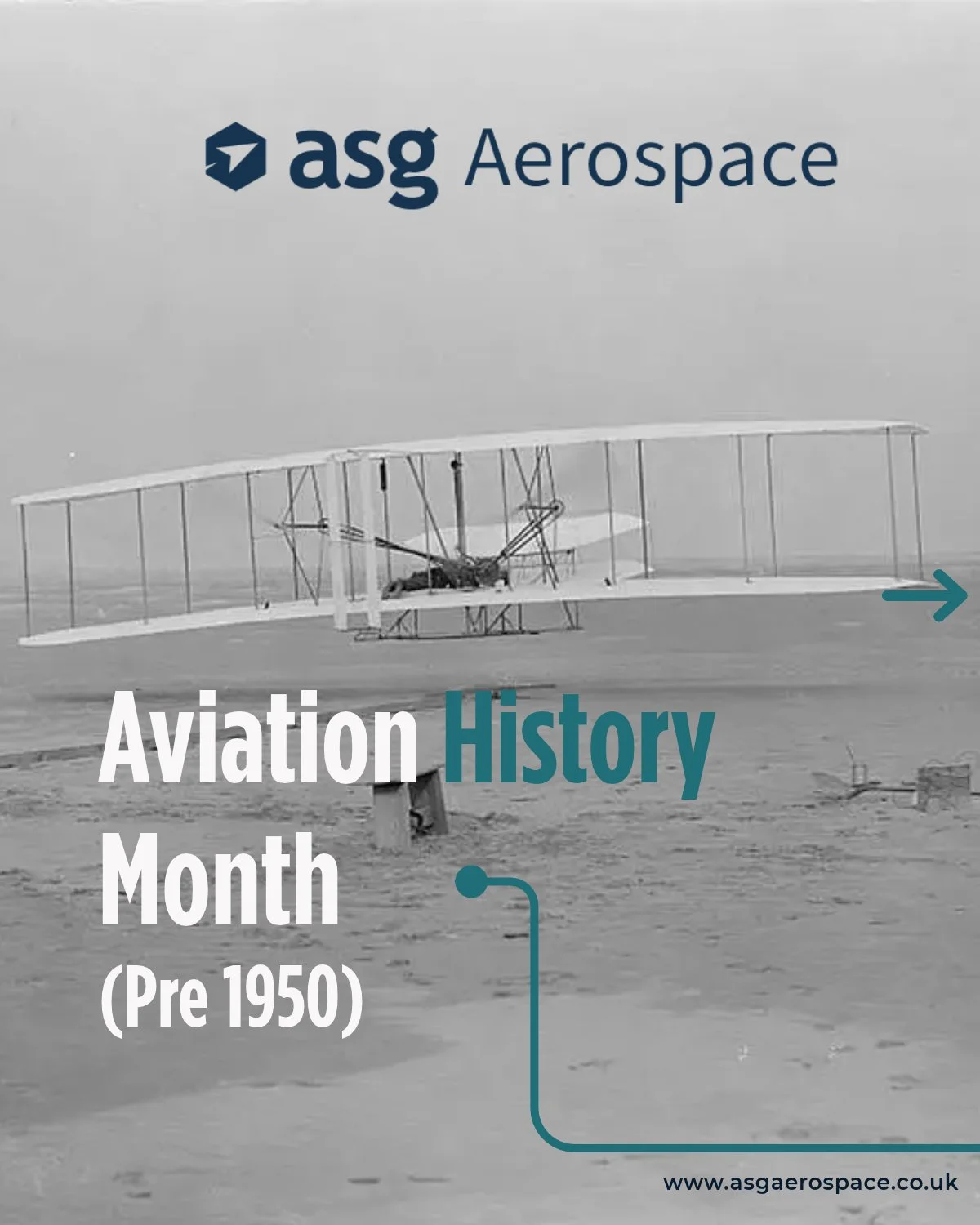
ASG Aerospace is celebrating Aviation History Month this November with a series looking back at the people and breakthroughs that shaped flight, beginning with the milestones before 1950.
Simon Weston, Chief Executive Officer of ASG Aerospace, said: “Think about how far aviation has come in a relatively short time. From the earliest glider experiments to aircraft carrying hundreds of passengers across continents, the progress has been extraordinary. Every generation has produced people who challenged conventional thinking and found new ways to make flight possible.”
The story begins in Yorkshire. Sir George Cayley, widely regarded as one of the founders of aeronautics, set out the principles of lift, drag and stability in the nineteenth century, and his glider experiments laid the scientific foundations of flight.
In December 1903, Orville and Wilbur Wright made the first sustained, controlled flight of a powered, heavier-than-air aircraft at Kitty Hawk, North Carolina. In 1932, Amelia Earhart became the first woman to fly solo across the Atlantic.
British engineering played a defining role in what followed. Sir Frank Whittle’s work on the turbojet engine ushered in the jet age. During the Second World War, Beatrice “Tilly” Shilling developed a modification to the Rolls-Royce Merlin engine’s carburettor that kept RAF fighters running during demanding manoeuvres.
Weston said: “When you look back at aviation’s greatest achievements, there is a common thread: talented people applying their knowledge and continually improving what is possible. That same spirit exists throughout our businesses today, and our teams take enormous pride in the precision and quality that modern aircraft demand.”
Follow ASG Aerospace throughout November and share your own favourite moment in aviation history.
